Family-Friendly Cooking Classes in Crete
Which Cretan cooking classes work with children, which to rule out on age, what kids get to do in the kitchen, and how to pick the right length, format and time of day for your family.
A cooking class can be one of the best family days on Crete, provided you pick the right one. A small class where children mix dough, fill pies, roll vine leaves and then sit down to eat what they made is the kind of afternoon a family talks about for years. A long, adult-paced session with a lot of standing, sharp knives and a wine tasting is a much harder sell to a seven-year-old.
So the question is not whether cooking classes in Crete suit children. It is which classes suit your children, at their ages and with their attention spans — and on this island the answer changes a great deal from one listing to the next.
Check Availability
Are cooking classes in Crete good for families?
Yes, particularly if you want something hands-on and cultural, slower than a full sightseeing day, and enjoyable for the adults as well.
They have one big advantage over most family tours: children are not just watching. In a genuinely hands-on class they can:
- mix ingredients
- knead or roll dough
- shape pies
- prepare salads
- fill vegetables
- roll vine leaves
- add herbs and seasoning
- help assemble the dishes
Then everyone eats the results together. On Crete the setting helps too, because most of these kitchens are gardens, courtyards and farms rather than indoor teaching studios.
The organic farm class at Stylos, twenty minutes from Chania, is the one families keep singling out in the reviews. It runs for five hours on a working farm with goats, chickens, lambs and rabbits, and everything is cooked over a wood fire with no electricity at all. It holds 5.0 across 17 reviews and costs from $134 per person. Our breakdown of the Stylos farm →
What age is best for a cooking class in Crete?
There is no universal minimum age. Each operator sets its own rule, and on Crete they range from none stated at all to sixteen.
Under 5
Possible, but usually the hardest age. Young children lose interest quickly, struggle with long sessions and cannot do many of the tasks. A shorter private or family-only class is the safest option — though see the note on private classes below before paying for one.
Around 6–9
This can work very well if the class is genuinely hands-on. Children of this age tend to love mixing, rolling, shaping and filling.
Around 10–12
Usually an excellent age. Children can take on much more of the preparation and start to enjoy the stories behind the recipes, which on a Cretan class are half the point.
Teenagers
Teenagers who like food can join most ordinary adult classes. They can use knives, work more independently and follow the longer recipes.
Always check the minimum age
Do not rely on a general promise that an experience is “family-friendly”. Check the individual listing, because the rules on Crete vary:
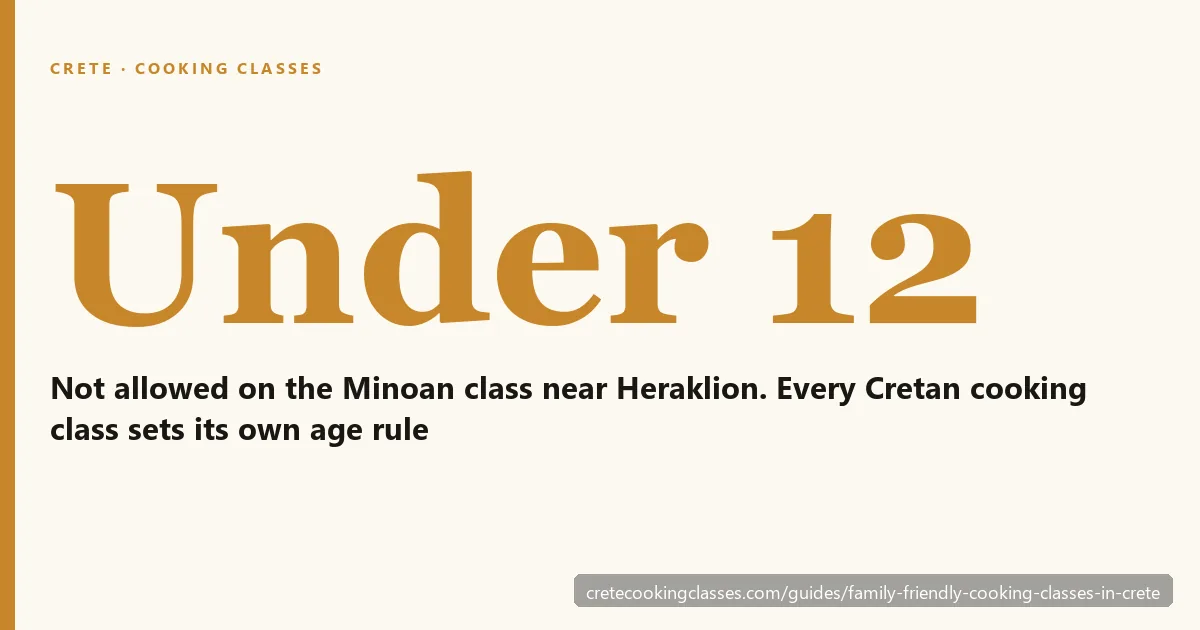
- The Minoan cooking class near Heraklion states it is not suitable for children under 12, or for pregnant women.
- The vegetarian cooking class with ouzo tasting excludes children under 10.
- A private Rethymno class with a chef excludes anyone under 16.
- The five-course class at AVLI in Rethymno excludes children under 4.
The reasons are usually some mix of knives, wood-fired ovens and hot surfaces, alcohol, a long running time and the transport involved. The seven classes with full breakdowns on this site state no age limit except the Minoan one, but “no limit stated” is not the same as “designed for children” — the next sections are about telling the two apart.
What do children actually do?
A good family class gives children real jobs, not a seat from which to watch the adults cook.
Making dough
Children often enjoy kneading and rolling more than anything else in the class, which is why Cretan pies work so well for families. At the home kitchen in Nerokourou, near Chania, the kalitsounia dough is rolled out and filled by hand while the lamb spends two hours in the oven.
Filling and shaping pies
Simple enough for younger children, and they end up with something recognisable that they made.
Rolling vine leaves
Once the host has shown the technique, most children can join in — and it quickly turns into a competition over whose dolmades are neatest.
Preparing salads and dips
Older children can chop; younger ones can mix, tear and assemble.
Stuffing vegetables
Gemista means scooping out tomatoes and peppers, filling them and arranging them in the tray, which gives small hands a clear job.
Picking herbs or vegetables
Farm and garden classes are especially good for children because the activity starts before anyone reaches the kitchen. At the garden class at Pigi, near Rethymno, the day’s menu is decided by walking the vegetable and herb beds with the host.
Why farm and village classes work well for families
Traditional farmhouse and countryside classes suit families especially well. Children get to explore a garden, see vegetables growing, smell the herbs, meet the people who produce the food, spend time outdoors and move between different activities.
That variety breaks up the session. Four hours that include a garden, the cooking and a meal feel much shorter than four hours in one kitchen.
On Crete, two experiences lean into this more than the rest. The Stylos farm has the animals and the wood fire. The 4x4 farm, pottery and cooking day starts at a working farm where you can try milking a goat, adds a village pottery workshop, and then cooks a Cretan lunch. It includes hotel pickup and holds 4.7 from 242 reviews, from $103 — but it is an eight-hour day with stretches of unsurfaced mountain track, and only about ninety minutes of it is at the kitchen. Our breakdown of the 4x4 day →
Private vs group cooking classes for families
Private cooking class
Usually better for younger children, larger families, children who need breaks, dietary restrictions, and families who want more flexibility.
The biggest advantage is pace. If a child gets bored or needs a break, you are not holding up anybody else.
Small-group cooking class
Can work very well for older children, teenagers, sociable families and anyone watching the budget. This is also where nearly all the reviews on Crete sit.
Large group class
This is the format to be most careful with. It tends to mean less participation, more waiting and more demonstration. If a listing does not state a group size, ask the operator before you book, and assume that younger children will get fewer jobs the bigger the table.
Is a private cooking class worth it for a family?
Often more so than for a couple. A private class solves several problems at once: a flexible pace, tasks chosen to suit your children, more of the host’s attention, and easier changes to the menu. The cost is also easier to justify when it is spread across several people.
The catch on Crete is evidence. Private and villa classes start at about $224 per person, or from about $336 to $885 per group, and a handful have one or two reviews while most have none. That leaves you paying more for a class almost nobody has vouched for, and at least one of them does not take children under 16 at all. For most families, a small-group farm or garden class is the safer booking. Private or group, in full →
Which Cretan dishes are best for children to make?
Kalitsounia
Small Cretan pies are ideal because children roll the dough, add the filling, fold it and shape each one themselves.
Dakos
A barley rusk topped with grated tomato, cheese, olive oil and oregano. Simple to assemble and easy for a child to understand.
Tzatziki
Very approachable, and easy for children to help with.
Dolmades
Rolling vine leaves turns into a fun challenge.
Gemista
Stuffing tomatoes or peppers gives children an obvious hands-on role.
Bread and dough dishes
Anything involving kneading tends to go down well with younger children. The Minoan class bakes a pie-bread in clay vessels, but remember that one is 12 and over.
Will children eat the food they make?
Not necessarily. Some children become more adventurous once they have made a dish themselves. Others still refuse to touch it.
If you have a very picky eater, check the menu beforehand. The Stylos farm lists its menu in full: tzatziki, dakos, Cretan salad, gemista, tsigariasto lamb, wood-fired potatoes and cheese pies. Potatoes and cheese pies cover most children.
Are cooking classes good for picky eaters?
They can be surprisingly good. Children often grow more interested in a dish after touching the ingredients, smelling them, helping to prepare them and watching them cook.
Do not treat the class as a way to make a child try new foods, though. The afternoon is still a success if they eat very little of it.
Food allergies
This is one of the most important things to check before you book.
Cretan cooking uses wheat, dairy, nuts, sesame, eggs and honey, and these are home and farm kitchens with shared surfaces, so cross-contamination is a real risk. One Chania listing states outright that it is not suitable for people with food allergies; the class with Stamatia near Rethymno asks to be told about allergies in advance.
If your child has a serious allergy, contact the operator directly through GetYourGuide before paying, explain the allergy clearly, ask about cross-contamination, and confirm what can be substituted.
Vegetarian and vegan children
Crete is very good for vegetarian families, because so much of the traditional repertoire is built on vegetables, grains, pulses, herbs, cheese and olive oil. The Pigi garden class prepares meat and vegetarian versions of the menu as standard.
Vegan children take more planning, because Cretan recipes also lean on cheese, yoghurt, eggs and honey. The vegetarian and vegan guide →
How long is too long for children?
Duration can make or break the day. A four-hour class sounds reasonable to an adult and very long to a six-year-old.
A long experience can still work if it mixes things up: a garden or farm visit, breaks, different cooking stages, outdoor space, and a meal. The classes on this site run from two hours (the Minoan class, which is over-12s only) to eight (the 4x4 day), with most at four or five. The White Mountains class above Chania is six hours door to door, including roughly 45 minutes of winding mountain road in each direction — easy for teenagers, a lot for a child who gets carsick.
For younger children, variety matters more than the number of hours on the listing.
Morning or evening cooking class with kids?
For most younger children, morning or early afternoon is the better choice. They have more energy, and you are not finishing well past their usual dinner or bedtime.
Evening classes can work well with teenagers. In Rethymno, Dining in Rethymno: An Evening of Cretan Cooking spends four hours cooking and then eating in a local host’s home, from $109 per person. It rates 5.0 but from only 13 reviews, so ask the host about children before booking.
Cooking class or food tour for families?
Cooking class
Better for children who like practical activities, making things and helping in the kitchen.
Food tour
Better for children who like exploring, walking and trying lots of snacks.
A cooking class usually holds children’s attention more consistently, because they have jobs to do. It is also the easier booking on Crete, where the food experiences worth booking are almost all cooking classes. Every Cretan food experience compared →
Cooking class or farm experience?
For younger children, a farm and cooking combination can be better than a pure cooking class, because it adds movement, outdoor time and animals to the ingredients, the cooking and the food. On Crete that is the Stylos farm, or the 4x4 day if your children cope well with a long day in a vehicle.
Can cooking classes work on very hot days?
Potentially. A shaded or indoor class can be a good alternative to sightseeing in the hottest part of the day.
Be careful in July and August, though, because two of the classes here are largely outdoors: the Pigi garden class is hot at midday in high summer, and the Stylos farm spends much of its time outside, over a fire. If you are travelling in peak summer, check whether the venue has shade, whether the cooking happens indoors or outdoors, and what time the class starts. The month-by-month view →
What should children wear?
Comfort over appearance: comfortable clothes, secure shoes, clothes that can take flour or sauce, and long hair tied back. On the farm and mountain classes add sun protection and closed shoes, because the ground is uneven.
Are cooking classes good for teenagers?
Often excellent. Teenagers can take part properly instead of being treated as children. They can use knives, prepare dishes on their own and learn recipes they can cook again at home.
If your teenager is interested in food, you do not need to search for “family” classes at all. A good small-group adult class suits them. The Nerokourou class near Chania is the most hands-on on this site, at 5.0 from 120 reviews, and the White Mountains class emails you the recipes and photographs afterwards.
How to choose a family-friendly cooking class in Crete
- Check the minimum age.
- Check the duration.
- Look for hands-on participation.
- Check the group size.
- Look at the menu.
- Confirm dietary requirements.
- Look at the venue.
- Check the transport.
- Check the finishing time.
- Read reviews from families.
Number eight changes the price. Only two classes on this site include transport — the White Mountains class and the 4x4 day. Where pickup is sold as an extra, it can cost real money: one operator near Kritsa charges €20 (about $22) per person for hotel pickup, which comes to €80 (about $88) for a family of four. With children, a car seat is a further reason to drive yourself, and wine is poured on all seven classes here, so decide in advance who is driving home.
Common mistakes
- Choosing the most famous class instead of the most suitable one.
- Assuming “family-friendly” means designed for children.
- Booking a full-day experience for very young children.
- Ignoring the transport time.
- Planning another big activity straight afterwards.
Best choice for families with young children
A private or very small-group class with a shorter duration and plenty of simple hands-on tasks.
A farm or garden setting is a big bonus. On Crete, with private classes still thinly reviewed at best, that points to the Stylos farm near Chania: small groups, animals, a wood fire and a menu with plenty a young child will eat.
Best choice for families with older children
A small-group traditional Cretan cooking class where everyone prepares several dishes and eats together afterwards.
The Nerokourou home kitchen near Chania or the Pigi garden near Rethymno both fit, depending on where you are staying.
Best choice for teenagers
Teenagers who enjoy cooking can usually join a standard small-group class. Prioritise hands-on preparation, interesting local dishes, a small group and the meal at the end.
Frequently asked questions
Are cooking classes in Crete suitable for children?
Many are, but minimum ages and formats vary by listing. The Minoan class near Heraklion is not suitable for children under 12, one vegetarian class excludes under-10s and one private Rethymno class excludes under-16s. Always check the individual experience before booking.
What age is best for a family cooking class?
School-age children and teenagers generally get the most out of it, because they can do more of the preparation. Some classes also take younger children, and a farm class such as Stylos near Chania keeps younger ones busy with the animals between cooking stages.
Do children actually cook?
In good hands-on classes, yes. They mix, roll, fill, shape and prepare different parts of the meal, while the host looks after the wood-fired oven and anything sharp or hot.
Are private cooking classes better for families?
They can be, especially for younger children, larger families and those who need flexibility. On Crete, though, most private classes have no reviews yet and the rest have one or two, so most families are better served by a small-group farm or garden class.
Can picky eaters still enjoy a cooking class?
Yes. They can enjoy making the food even if they do not eat every dish afterwards. Check the menu in advance: the Stylos farm menu, for example, includes wood-fired potatoes and cheese pies.
Which cooking class in Crete is best for families?
The organic farm at Stylos, twenty minutes from Chania: five hours on a working farm with goats, chickens, lambs and rabbits, everything cooked over a wood fire, rated 5.0 across 17 reviews. The 4x4 day trip, with goat milking, a pottery workshop and hotel pickup, suits families with older children who are happy with a long day.
Final verdict
A cooking class can be one of the most successful family activities in Crete, because everyone takes part in the same experience at their own level.
The best family option is not necessarily the class with the biggest menu or the longest itinerary. Look for a manageable duration, genuinely hands-on cooking, a small group and a host who is comfortable with children.
For younger children, a farm-based class is usually the safest choice. For older children and teenagers, a small-group traditional cooking class can be one of the most memorable ways to experience Cretan culture as a family.
Ready to book?
Compare all seven classes on price, region, length and transport in the guide to choosing one, or browse every Cretan cooking class on this site. Free cancellation up to 24 hours before, and nothing to pay today.
Cook a Cretan Meal, Not a Greek One
Dakos, gemista, kalitsounia and lamb from a wood-fired oven — cooked by you, in a garden, with wine poured throughout. Free cancellation up to 24 hours before.
Check Availability & Book