One-Day Cooking Classes in Crete
Most Cretan cooking classes take four or five hours, not a whole day. What you can learn in one session, how long to book, which dishes to prioritise, and how to spot a class that is mostly transport and lunch.
If you like the idea of learning Cretan cooking but do not want to give up a week of your holiday to a course, a one-day class is the right compromise. You get enough time to cook several dishes, understand the basics of Cretan ingredients and sit down to a proper meal, without losing more than an afternoon.
For most visitors, this is exactly the right format. A single class will not make you an expert in Greek cuisine. What it can give you is a practical introduction to traditional Cretan dishes, local ingredients, simple techniques and the food culture of the region — plus recipes you can cook again at home.
Check Availability
What is a one-day cooking class in Crete?
“One-day” is slightly misleading. Most visitor classes on Crete do not run from morning to evening: the classes reviewed on this site run from two hours to eight, and most take four or five. They are better described as half-day classes, afternoon or evening classes, cooking-and-dinner experiences, or farm and village days.
A typical class includes:
- a welcome and introduction
- an explanation of the ingredients
- hands-on preparation
- several traditional recipes
- cooking time
- a meal
- local wine or another drink
- recipes or notes to take home
Longer versions add a garden walk, a farm, an olive-oil or cheese tasting, or a village visit. The Nerokourou home kitchen near Chania is the classic shape: four hours, a real family garden, lamb in a wood-fired oven, and everything you made eaten at the table with wine and raki. It holds 5.0 from 120 reviews and costs from $123. Our breakdown of the Nerokourou class →
Is one day enough to learn Cretan cooking?
Not completely. Cretan cooking covers breads, pies, vegetables, legumes, meat dishes, cheeses, desserts and regional specialities, and nobody learns that in an afternoon.
But one day is enough to understand the fundamentals: how olive oil is used, how herbs are combined, how a few simple ingredients build flavour, how the doughs are handled and how a Cretan meal is put together.
What can you learn in a few hours?
A good class does not need to teach dozens of dishes. It needs to teach a few of them well.
You might learn dakos, tzatziki, dolmades, gemista, kalitsounia, boureki, a seasonal vegetable dish, slow-cooked meat or a simple dessert. The exact menu matters less than whether you are genuinely involved in making it.
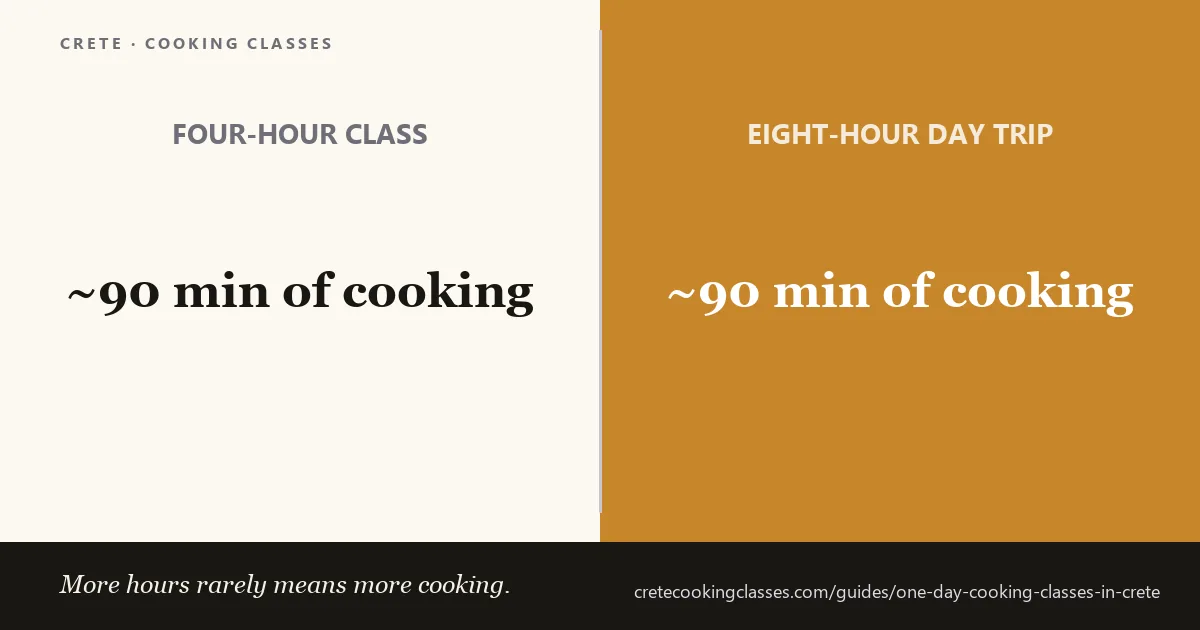
Be realistic about the clock, too. A four-hour class is roughly forty minutes of welcome, half an hour in the garden, ninety minutes of cooking and two hours at the table. What happens hour by hour →
Best dishes to learn in a one-day class
Dakos
Simple, quick and very Cretan: barley rusk, tomato, olive oil, cheese and herbs. It teaches the olive-oil lesson in one plate.
Dolmades
Useful because you learn to fill and roll vine leaves properly — the knack that is almost impossible to pick up from a video.
Gemista
Stuffed vegetables teach several things at once: preparing the vegetables, making a filling, seasoning and baking.
Kalitsounia
Cretan pies are especially valuable because you learn dough texture, rolling, filling, shaping and sealing. At Nerokourou the dough is rolled and filled by hand while the lamb is in the oven.
Boureki
The one to learn if you are staying around Chania: potatoes, courgettes, herbs and cheese, layered and baked, and very much a western Crete dish.
Is a short class better than a full-day experience?
Shorter is better if you are only on Crete for a few days, want to keep time for sightseeing, mainly want to cook, or do not need a farm or village tour.
Longer is better if you love food, want more cultural context, travel slowly, and want a garden, farm or tasting element.
For many travellers, a focused three- to four-hour class is enough. Watch what the longer ones spend their extra hours on:
| Class | Length | What fills it |
|---|---|---|
| Minoan class near Heraklion | 2 hours | Estate tour, then cooking in clay vessels over a wood fire |
| Chrysoula’s home kitchen, east of Rethymno | 3.5 hours | Greek coffee welcome, cooking in an outdoor covered kitchen with a wood oven, starter, main and dessert |
| Nerokourou home kitchen, Chania | 4 hours | Garden, the most hands-on cooking on this site, long meal |
| Pigi garden class, Rethymno | 4 hours | Walk the beds to pick the menu, cook outdoors, eat in the garden |
| Stylos farm, Chania | 5 hours | Working farm and animals, everything over a wood fire |
| White Mountains, Chania | 6 hours | Hotel pickup, about 45 minutes of mountain road each way |
| 4x4 day trip, Lasithi | 8 hours | Off-road drive, farm, pottery, olive mill — about 90 minutes of cooking |
Six hours at the White Mountains class does not mean two more hours of cooking than Nerokourou; it means transport. The 4x4 day is an excellent day out and ninety minutes of cooking lesson.
One-day cooking class vs multi-day cooking course
One-day class
Best for tourists, beginners, couples, families and casual food lovers.
Multi-day course
Better for serious home cooks, culinary travellers and people planning a whole trip around food.
If you are on a normal holiday in Crete, a multi-day programme is usually unnecessary — and it is hard to find one anyway. We have not found a multi-day course among the island’s cooking-class listings on GetYourGuide; if you want more than one session, book two different classes in two regions, which also shows you two different parts of the island.
Can beginners learn enough in one day?
Yes. The classes are designed for beginners, and one of them — the class with Stamatia near Rethymno — states in its listing that no previous cooking experience is required.
You will pick up basic preparation, simple knife work, rolling, mixing, seasoning, stuffing and dough handling. Nobody expects you to master advanced pastry or restaurant technique. Cooking classes for beginners →
How hands-on should a one-day class be?
Very. If you only have one class, you want as much of it as possible spent preparing food.
Look for reviews saying “we made”, “we prepared”, “very hands-on” or “everyone participated”. Be more cautious if reviews keep describing the experience as “watched” or a “demonstration” — and if the listing itself says demonstration, believe it.
Small group or private?
Small group is usually the best value. You take part, meet other travellers, learn from the questions they ask, and share the meal. It is also where all the reviews on Crete sit.
Private is better if you want individual attention, have particular dishes in mind, have dietary requirements, or are celebrating something. On Crete, private and villa classes start at about $224 per person, or from about $336 to $885 per group, and a handful have one or two reviews while most have none. Private or group, in full →
Is a one-day class good for couples?
Yes. It combines an activity, food, conversation and dinner, which is most of a good date.
For couples, look for a small group, a countryside setting, evening timing, dinner included and wine included. Wine is included on every class reviewed on this site. Cooking classes with wine →
Is it good for families?
Yes, but the length matters. A five- or six-hour class can be too long for younger children.
For families, choose on minimum age, group size, pace, hands-on tasks and the venue. The Stylos farm is five hours, but the animals and the garden break it up; the Minoan class is only two hours, but takes no one under 12. Family-friendly cooking classes →
Morning vs afternoon
Morning suits you if you want the evening free, or the class includes a garden or farm you want to see in good light. The Minoan class pairs well with a morning at Knossos — same civilisation, and this is the half you can eat.
Afternoon suits you if you want dinner included and the wine to be part of it. Nerokourou runs as lunch or dinner depending on the start time you book.
For most holidaymakers, afternoon into evening is the most natural shape. In July and August, keep the outdoor classes — Pigi and Stylos — away from midday.
Does a one-day class include a meal?
On Crete, yes: every class reviewed on this site ends with a full meal of what you cooked, and it is one of the best reasons to book.
The meal is the natural end of the class. If a listing says “cooking class” and does not say clearly that you eat a full meal, check before booking.
Should you choose a class with a market visit?
If you enjoy ingredients, a market visit makes the cooking more meaningful: you see the vegetables, herbs, cheese, olives and local products before you use them. The drawback is that it takes time away from the cooking.
On Crete the garden plays that role. None of the classes on this site includes a market, but at Pigi and in the White Mountains you walk the vegetable and herb beds and pick what you are about to cook — which is closer to the source than any market.
Should you choose a farm-based class?
It can be one of the best formats. A farm or garden adds context, scenery, seasonal produce and more variety to the day.
The Stylos farm near Chania grows its ingredients organically on site and cooks everything over a wood fire without electricity; it holds 5.0 across 17 reviews and costs from $134.
Do you get recipes afterwards?
Sometimes. Recipes may be printed, emailed or available on request. The White Mountains class emails the recipes and your photographs afterwards; Stamatia’s class near Rethymno sends you home with family recipes and cooking tips.
If you want to cook the dishes again, take your own notes too: textures, consistency, substitutions and rough quantities — the things a recipe leaves out.
Can you recreate the dishes at home?
Some, yes. The main problem is ingredients: you may struggle to find exact equivalents for local cheeses such as mizithra, for wild greens and herbs, or for barley rusks.
Ask the host for substitutions while you are there. They are used to the question.
Vegetarian, vegan and gluten-free options
Vegetarians can usually be catered for with advance notice, and the Pigi garden class prepares vegetarian versions as standard. Vegans need to check more carefully, because traditional recipes use cheese, yoghurt, eggs and honey.
Gluten-free travellers should ask about flour, bread, pastry, rusks and cross-contamination — dakos is barley by definition. The vegetarian and vegan guide →
Is a one-day class worth it if you already cook?
Potentially. Experienced cooks may know the techniques already, but the value is in the Cretan ingredients, the regional recipes and the food culture.
If you are confident in the kitchen, pick a small class where you can ask detailed questions. The Nerokourou class, the most hands-on on this site, is the one to book.
How to choose the best one-day cooking class in Crete
Look at:
- duration
- group size
- hands-on cooking
- menu
- location
- transport
- meal
- drinks
- dietary options
- recipes
Transport is the one that changes the price. Only two classes on this site include it — the White Mountains class and the 4x4 day. Where pickup is sold as an extra it adds up: one operator near Kritsa charges €20 (about $22) per person for hotel pickup.
Common mistakes
- Booking the longest class automatically.
- Confusing a demonstration with a class.
- Booking too much on the same day.
- Eating too much beforehand.
- Ignoring the return time.
Best one-day class for first-time visitors
A small-group traditional Cretan cooking class lasting around half a day, with several hands-on dishes and a full meal at the end.
With a car, that is the Nerokourou class: four hours, fifteen minutes from Chania, from $123. Without one, the White Mountains class, which picks you up from your hotel — from $123, six hours, 4.9 from more than 700 reviews.
Best one-day class for couples
Late-afternoon cooking + dinner + local wine.
The dinner sitting at Nerokourou. Near Rethymno, the four-hour Dining in Rethymno: An Evening of Cretan Cooking cooks and eats in a local host’s home with drinks included, from $109; it rates 5.0, but from only 13 reviews so far.
Best one-day class for families
A shorter small-group or private class with lots of simple hands-on tasks.
The Stylos farm near Chania, where the animals keep younger children busy between cooking stages.
Frequently asked questions
Can you take a one-day cooking class in Crete?
Yes. Every class reviewed on this site is a single session built for visitors — from two hours for the Minoan class near Heraklion to eight for the 4x4 day trip, with most at four or five hours.
Is one day enough to learn Cretan cooking?
Not comprehensively, but it is enough to learn several dishes and the basic techniques and ingredients. Most classes teach four to six dishes, and roughly ninety minutes of a four-hour class is spent cooking.
Are one-day cooking classes suitable for beginners?
Yes. Visitor classes require no previous cooking experience; the class with Stamatia near Rethymno says so in its listing. The host demonstrates each step before you try it.
How long is a cooking class in Crete?
Two to eight hours. The two-hour Minoan class is the shortest; Chrysoula’s class east of Rethymno takes three and a half; the Nerokourou and Pigi classes take four; the White Mountains class takes six including transport; the 4x4 day takes eight but spends only about ninety minutes of it cooking.
Final verdict
You do not need a week-long culinary programme to get something real out of cooking in Crete.
A well-run one-day class can teach you a handful of traditional dishes, several useful techniques and how Cretan ingredients work together.
Look for a small group, genuinely hands-on preparation, a good traditional menu and a full meal afterwards. If you want more atmosphere, add a village or farm setting.
Ready to book?
Compare all seven classes on price, region, length and transport in the guide to choosing one, or browse every Cretan cooking class on this site. Free cancellation up to 24 hours before, and nothing to pay today.
Cook a Cretan Meal, Not a Greek One
Dakos, gemista, kalitsounia and lamb from a wood-fired oven — cooked by you, in a garden, with wine poured throughout. Free cancellation up to 24 hours before.
Check Availability & Book