Which Cooking Class in Crete Is Right for You?
Every Cretan cooking class on this site compared on price, region, length, transport and reviews — plus whether they're worth it, how hands-on each one is, private vs group, group sizes, and the traps to check before you pay.
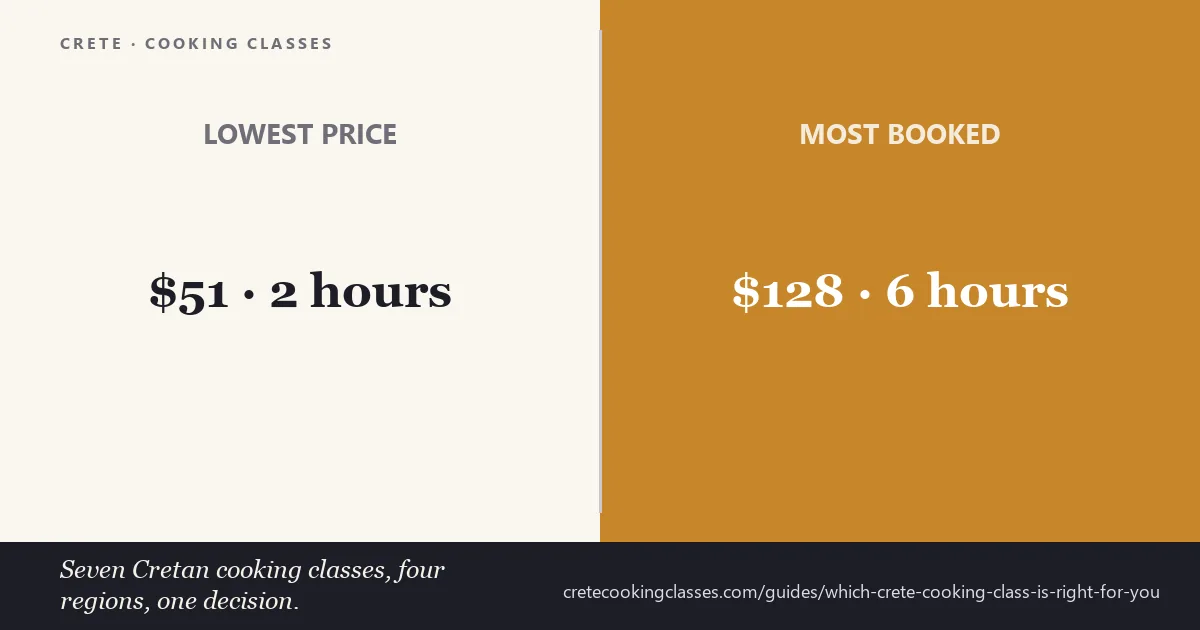
Seven cooking classes, four regions, and prices from $61 to $134. If you are staying anywhere near Chania and want one recommendation, book the White Mountains class — six hours, 4.9 from more than 700 reviews, and the only Chania class that sends a minivan to your hotel. Everything below is for everyone else.
Check Availability
The seven, side by side
| Class | From | Length | Rating · reviews | Transport | Best for |
|---|---|---|---|---|---|
| Chania — White Mountains | $123 | 6 hr | 4.9 · 727 | ✓ included | Most people |
| Chania — Nerokourou home | $123 | 4 hr | 5.0 · 120 | ✗ | A real home kitchen |
| Chania area — Stylos farm | $134 | 5 hr | 5.0 · 17 | ✗ | Families |
| Rethymno — Pigi garden | $117 | 4 hr | 4.8 · 31 | Extra charge | Vegetarians |
| Rethymno — Chrysoula’s home | $113 | 3.5 hr | 5.0 · 129 | ✗ | A family home near Arkadi |
| Lasithi — 4x4 day trip | $103 | 8 hr | 4.7 · 242 | ✓ included | Seeing the interior |
| Heraklion — Minoan class | $61 | 2 hr | 5.0 · 8 | ✗ | Lowest price |
Every figure is the operator’s own GetYourGuide listing at the time of writing. Ratings drift as reviews land; the booking page always shows the current number.
The short answer
Pick by where you are staying first, because the drives are long. Then pick by format — home kitchen, working farm, garden or day trip. Price is the last thing to sort on, because once you add the taxi fare to a village kitchen the gaps mostly close.
One question sits underneath all of that and is worth settling early: private or group. Every class in the table above is a shared class, and that is not an accident of what we chose to cover — it is what Crete actually sells with any evidence behind it. The full case is further down.
Is a cooking class in Crete worth it?
For anyone who enjoys food, yes. A class bundles several things into one booking — a local host, traditional dishes, an explanation of the ingredients, a full meal and usually wine — and it gives you a recipe you can cook again at home, which a restaurant dinner or a sightseeing tour cannot. The ratings back it up: every class on this site sits above 4.7, high even by GetYourGuide’s own standards.
It suits food lovers, couples, families, solo travellers and repeat visitors especially well. It suits fewer people if the stay is very short, if organised group activities are not your thing, or if you specifically want professional-level technique rather than a traditional home kitchen — a tourist class is built to be approachable, not to train a chef. The full pros-and-cons case, and who should skip it →
If you are staying in Chania
You have the best choice on the island, and three genuinely different classes. None of them is in the Old Town itself — “Chania cooking class” almost always means a village, a family home or a farm somewhere in the wider region, so check the meeting point before assuming it’s walking distance from the Venetian harbour. If one dish justifies leaving town for, it’s boureki — the courgette, potato, cheese and herb bake most closely associated with this part of the island, and the clearest sign a class is teaching Chania rather than generic Greek food.
The White Mountains class is the one to book if you have no car. Six hours, a minivan from your hotel, a garden walk, a short mountain walk to a shepherd’s hut, and a full meal with wine. It rates 4.9 from more than 700 reviews — more than the rest of this site combined — and recipes plus photographs are emailed afterwards. Our breakdown → · What to know before you book it →
The Nerokourou class is the one to book if you do. It is fifteen minutes from town in a family home, it holds 5.0 across 120 reviews, and the teaching is the most hands-on of the three: wood-fired lamb, dolmades rolled by you, kalitsounia dough rolled by you. There is no transport, so budget a taxi both ways. Our breakdown →
The Stylos farm, twenty minutes out in Apokoronas, is the family pick — goats, chickens, lambs and rabbits, everything cooked over a wood fire with no electricity at all, and organic ingredients picked from the garden you just walked through. It is the most expensive class here, from $134, and the reviews are unanimous about why. Our breakdown →
If you are staying in Rethymno
There are two good choices here, and they feel quite different.
The garden class at Pigi is a genuinely relaxed afternoon: a large garden, tables under the trees beside a pool, a wood-fired oven already hot when you arrive. It is the one class here that prepares meat and vegetarian menus as standard, which makes it the default recommendation for vegetarians. Hotel pickup exists but costs extra. Our breakdown →
Chrysoula’s home cooking lessons take place in her family’s home in a village in the Arkadi area, east of Rethymno, in an outdoor covered kitchen with a traditional wood oven. You are welcomed with Greek coffee or herbal tea, homemade lemonade and ladokouloura, then cook a starter, a main and a dessert — dakos, gemista, moussaka or cheese pies with honey are typical — with local wine and raki at the table. It is three and a half hours, from $113, rated 5.0 from 129 reviews, and the menu can be adapted for vegetarians and allergies. There is no pickup, so you need a car or a taxi. Our breakdown →
If you are staying near Heraklion or the east
The Minoan class east of Heraklion is the cheapest and by some distance the most unusual: a 4,000-year-old menu cooked in clay vessels copied from archaeological finds, over a wood fire. Panspermia, Minoan pie-bread, briam, dakos. Two hours, from $61, and it pairs neatly with a morning at Knossos. The catch is a hard one — the operator states it is not suitable for children under 12 or for pregnant women. Our breakdown →
If you want a day out, not an afternoon
The 4x4 day trip is eight hours through the interior with roughly ninety minutes of cooking in the middle: a working farm with goat milking, off-road mountain tracks, a gorge, the Lasithi Plateau, a pottery workshop, the ancient plane tree at Krasi and an olive mill. Hotel pickup is included and it runs in six languages. Book it for the island; do not book it expecting a cooking class. Our breakdown →
If you are watching the budget
The Minoan class, from $61, is the only class on this site under $100, but it is two hours and no meal in the sit-down sense — you cook a menu and taste it. The Kissamos cooking class and Greek night that used to fill the cheap-evening slot is no longer sold.
Above that, the gaps are small. Chrysoula’s class near Arkadi is from $113 for three and a half hours with a full meal, wine and raki, and the 4x4 day trip is from $103 with hotel pickup included. For a full evening in Rethymno, Dining in Rethymno: An Evening of Cretan Cooking is from $109 for four hours in a local host’s home, with drinks included and a meeting point in Loutra, just east of town. It rates 5.0, but from only 13 reviews, so the record behind it is still thin.
How hands-on is a Cretan cooking class?
“Cooking class” covers a wider range than the word suggests, and knowing which shape you’re booking changes what you should expect.
Fully hands-on. Guests prepare most of the dishes themselves, with the host demonstrating each step first. The Nerokourou class is the clearest example on this site: wood-fired lamb, dolmades rolled by you, kalitsounia dough rolled by you.
Shared group cooking. Different guests work on different parts of the same meal, then everyone eats together. This is the standard shape here — the White Mountains class, Pigi and Stylos all work this way.
Culinary experience. Cooking is one part of something larger, rather than the whole point. The 4x4 day trip is the example here: it spends roughly ninety minutes of its eight hours at the kitchen, and the farm, the mountain tracks and the pottery workshop fill the rest.
None of the seven classes on this site markets itself as a pure demonstration, where guests mostly watch — useful to know if that’s the format you were trying to rule out.
Private or group?
Choose a private class if you want individual attention, a quieter room, flexibility on menu and pace, privacy, a special-occasion atmosphere, or dietary requirements handled properly rather than accommodated.
Choose a small-group class if you want better value, a sociable afternoon, other travellers to cook with, a relaxed shared table, and the traditional version of the experience.
For most first-time visitors the small group is the better balance of price, participation and atmosphere. On Crete specifically, it is also the only side of that choice with any evidence behind it — see the review problem below.
What a private class actually is
Reserved for your party only: one person, a couple, a family, a group of friends. You are not placed with strangers; the host runs the experience for you alone. That usually means a more personal atmosphere, more room to ask questions, and — depending on the operator — more flexibility on menu, timing, pace and difficulty.
“Private” does not automatically mean customised. Often it just means nobody else joins you, on the same fixed programme everyone else gets.
What a group class actually is
Travellers who booked separately, brought together: couples, solo visitors, families, friends. The class follows a set programme and everyone prepares the dishes together. The good ones are small enough that everyone genuinely participates; a large one drifts towards demonstration.
At a glance
| Private class | Group class | |
|---|---|---|
| Privacy | Excellent | Limited |
| Personal attention | High | Shared |
| Social atmosphere | Low to moderate | High |
| Flexibility | Usually better | Usually fixed |
| Price on Crete | From about $224 a person | $61–$134 a person |
| Romantic feel | Better | Depends on the group |
| Best for couples | Excellent, in principle | Very good |
| Best for solo travellers | Expensive | Excellent |
| Dietary flexibility | Often better | More limited |
| Best for families | Excellent | Depends on the children |
| Meeting other travellers | No | Yes |
| Reviews to judge it on | A few at most | More than 700 |
| Best value | Moderate | Usually better |
The review problem, which is specific to this island
Private and villa cooking classes on Crete start at about $224 per person, or from about $336 to $885 for the whole group, depending on the listing and the size of the party. A handful have one or two reviews; most have none at all.
That is not a claim that they are bad. It is a statement that almost nobody has reported back on them, at two or more times the price of a class with hundreds of reports behind it. If you book one, message the host through GetYourGuide first and ask how long, how many courses, and who does the cooking.
Is private better?
Not automatically. Private buys privacy, attention and flexibility — and those are not necessarily what makes a cooking class enjoyable. A lot of the pleasure is social: preparing food alongside strangers, laughing when something collapses, comparing plates, drinking wine round the same table. A fully private session can tip into feeling like a formal lesson. A good small-group class in a family home often feels warmer.
Is private worth the extra cost?
Sometimes. You are paying for exclusivity, the host’s undivided attention and possibly more flexibility. You are not necessarily paying for better food, more dishes, a longer session or more expensive ingredients — and on Crete you are also paying for a listing with little or no review record. If a private class is much more expensive, compare the inclusions line by line before assuming the gap buys anything.
Does private mean more hands-on?
Often, but not reliably. How much cooking you do is a property of how the class is designed, not of who else is in the room. A private experience can still have the host doing the difficult work; a small-group class can be relentlessly hands-on — the Nerokourou class is the most demanding on this site and it is a shared one. Look for wording like “hands-on”, “prepare several dishes”, “cook alongside the host” or “participate in every stage”.
Can a private class adapt the menu?
Usually more easily than a group class, but never assume it. Plenty of traditional classes run a fixed menu whether the group is private or not, because the menu is what is ripe in the garden that week.
Which is more authentic?
Neither. Authenticity is not a function of group size. A private session can be immaculately personal and still built entirely for visitors; a shared class can happen in a real family home and teach recipes that have not changed in three generations. What matters is who hosts it, where it happens, what you cook and whether the ingredients are local.
Which has the better atmosphere?
Private tends to be calm, intimate and focused. Group tends to be lively, spontaneous and communal. Cretan food culture is emphatically social — the long table is the point — so a shared class followed by a shared meal is arguably the more native version of the experience.
Who each format actually suits
Couples
Private for a honeymoon, anniversary or a night that has to be special; small-group if you are mainly there for the food, enjoy meeting people and want the better value. For an ordinary holiday afternoon we would take small-group every time.
For romance specifically, prioritise setting, group size, evening timing, dinner and wine over exclusivity — a private session in a plain commercial kitchen beats nothing, and loses badly to a shared class in a garden at Pigi. The full couples guide →
Solo travellers
Group, clearly. You avoid the private premium — from $123 for the Nerokourou home kitchen against about $224 per person for the cheapest private class — and a long table with eight strangers who have just cooked together is one of the easiest social settings there is.
Families
Private has real advantages: children can work at their own pace, take breaks, ask more, and be given simpler jobs. Group classes work well for older children and teenagers, especially sociable ones. On this island the strongest family option is a shared one anyway — the Stylos farm, where the animals and the open fire do the work that a private host otherwise would.
Beginners
A private class gives more help than most beginners actually need. A good small-group class is comfortably enough, and the attention is not permanently on you, which most first-timers prefer. Are these classes beginner-friendly? →
Travellers with dietary requirements
Private is easier to adapt for vegetarian, vegan, gluten-free or allergy needs. But on Crete the shared classes handle it well too: the Pigi garden class prepares meat and vegetarian menus as standard, and everywhere else a message to the host after booking is normally enough. The vegetarian and vegan guide →
Budget-conscious travellers
A private class costs more because the host’s time is divided among fewer people — that is the whole of the price difference, and it buys attention rather than food. If the goal is simply to cook and eat Cretan food properly, a shared class gives you more for the money, and on this island it gives you more of nearly everything else too. The cheapest well-reviewed option is from $61; the cheapest private one is about $224 per person.
Experienced cooks
Private lets you go deeper and ask technical questions. So does arriving early to a small class and talking to the host, for a third of the price.
Anyone who dislikes group activities
If making conversation with ten strangers over a chopping board reads as work rather than fun, private is worth paying for — with the review caveat above firmly in mind.
Large families and groups of friends
If you are already a group, private starts making straightforward sense: the per-person gap shrinks as the party grows, and you get the room to yourselves. Birthdays, family reunions, friendship groups and wedding parties are the clearest cases for it on this island.
Small group vs large group
Six people and twenty people are both “group classes” and they are not remotely the same experience.
A small group is better for participation, for asking questions, for seeing the demonstrations properly, for talking to the host, and for the atmosphere at the table afterwards.
A large group can be cheaper and livelier, but usually means less cooking per person, more waiting and less attention.
If you want to actually learn something, find the maximum group size before you book, and treat “small-group experience” in a title as marketing until the description confirms a number. Two on this site are capped by physics rather than policy: the Nerokourou class runs in a real home kitchen, and the White Mountains class is sold as a small-group class.
How to compare prices
Never compare two prices without comparing what is inside them. A private class can look expensive and include hotel pickup, a full meal, drinks and several hours of hosting; a cheaper group class can include much less. On Crete the specific line to check is transport — only two of the seven classes here include it. For scale, one operator near Kritsa charges €20 per person (about $22) for hotel pickup, and a taxi there and back for two can easily cost more.
Questions to ask before you book
Before a private class: Is it genuinely private, or just a small departure? Is the menu fixed? Are dietary requirements actually accommodated? Is transport included? How much of the cooking do guests do? Is dinner included? Is wine included? Can children take part?
Before a group class: What is the maximum group size? Does everyone participate, or is it partly demonstration? What language is it run in? Is the meal shared at one table? Can dietary requirements be handled?
The four mistakes people make:
- Assuming “small group” means very small.
- Paying for private when nothing about the occasion needs it.
- Choosing the cheapest group class without checking how big it is.
- Assuming private automatically means more hands-on, or more authentic.
Best value: a small-group class. Interaction, hands-on cooking, a host who has time for you, a social table and a meal — at a fraction of the private price.
Best premium choice: a private class, when the privacy itself is the point. A honeymoon, an anniversary, a family group, a serious dietary need, or an experienced cook who wants the host’s full attention. Go in knowing you are the first reviewer.
Things worth checking before you pay
Transport is the hidden variable. Only two of the seven include it. Getting to a village kitchen and back on your own adds a real cost per party, often enough to reverse the ranking of two classes that looked differently priced.
Wine is included on all seven, and raki on most, poured throughout. Decide who is driving before you book a class you have to drive to.
Say what you eat when you book. Vegetarian is easy on Crete and almost never stated in the listing. Message the host through GetYourGuide after booking so the shopping is done for it.
Review counts vary hugely. Two classes here carry hundreds of reviews and two carry fewer than twenty. A small count is not a red flag on a new listing, but it does mean the rating is carrying less weight than the number suggests.
One listing is deliberately absent. A Lasithi Plateau cooking lesson currently rates 2.6 across four reviews — the only badly-rated cooking class on the island. It is not on this site.
Who should book, and who should skip it
Especially good for: food lovers, couples, families, solo travellers, repeat visitors, and anyone who prefers a hands-on afternoon to another sightseeing stop.
A poorer fit if: your stay is only a day or two and the sights come first, you dislike organised social activities, or your goal is professional-level technique — none of these seven classes is built to train a chef.
Frequently asked questions
Are cooking classes in Crete worth it?
For food-loving travellers, yes. They combine a local host, hands-on cooking, ingredient explanations and usually wine into one booking, and every class on this site rates above 4.7. They suit fewer people on a very short stay, or if professional technique matters more than atmosphere. The advantages and downsides in full →
What is the best cooking class in Crete?
By review volume and rating together, the White Mountains class above Chania: 4.9 from more than 700 reviews, the largest review base in the niche by a wide margin, and the only Chania class that includes hotel pickup. If you want the highest raw rating, the Nerokourou home kitchen holds 5.0 across 120 reviews, and Chrysoula’s home kitchen near Rethymno holds 5.0 across 129.
What is the cheapest cooking class in Crete?
The Minoan class east of Heraklion, from $61 for two hours, and the only class on this site under $100. For a full evening with a meal, the Dining in Rethymno evening is from $109, though it has only 13 reviews so far.
Is it worth leaving central Chania for a cooking class?
Usually. The strongest classes in the region — the White Mountains, Nerokourou and Stylos — all sit outside the Old Town, and the travel is part of what makes them good: a village, a family garden or a working farm rather than a room set up for visitors. Check the exact meeting point before booking so the transfer doesn’t surprise you.
Do I need a hire car for a cooking class in Crete?
For five of the seven, effectively yes — or a taxi. Only the White Mountains class and the 4x4 day trip include transport. The village kitchens sit a short drive outside the towns.
Which cooking class in Crete is best for families?
The Stylos village farm near Chania. Five hours, a working organic farm with goats, chickens, lambs and rabbits, and cooking over an open wood fire, all of which gives children something to do. Avoid the Minoan class, which excludes under-12s.
Is a private cooking class in Crete worth it?
It can be — for a honeymoon, an anniversary, a family group, a real dietary need, or anyone who would rather not cook alongside strangers. The complication on this island is that private classes start at about $224 per person and most have no reviews at all, while shared classes run from $61 to $134 and the best-known has more than 700 reports behind it. Worth it when the privacy itself is the point; a poor trade otherwise.
Are private cooking classes more hands-on?
Often, but not reliably — it depends on how the class is designed rather than on who is in the room. The most hands-on class on this site is a shared one, in a family home outside Chania.
Are group cooking classes in Crete crowded?
Some are and some are not, and the listing title will not tell you. Check the maximum group size in the description. The home-kitchen and mountain classes here are capped small by the size of the kitchen and the minivan.
Is a group class better for solo travellers?
Usually, yes. It costs a fraction of a private class and gives you a natural way to meet people — several hours of cooking together, then a long shared table.
How far ahead should I book?
As soon as your dates are fixed. None of the listings gives a lead time, and the booking page sometimes marks a date as likely to sell out. Reservations take no payment today and cancel free up to 24 hours before, so booking early carries little risk.
Ready to book?
Check dates and prices for the class you have picked, or compare all seven on one page. Free cancellation up to 24 hours before, and nothing to pay today.
Cook a Cretan Meal, Not a Greek One
Dakos, gemista, kalitsounia and lamb from a wood-fired oven — cooked by you, in a garden, with wine poured throughout. Free cancellation up to 24 hours before.
Check Availability & Book